
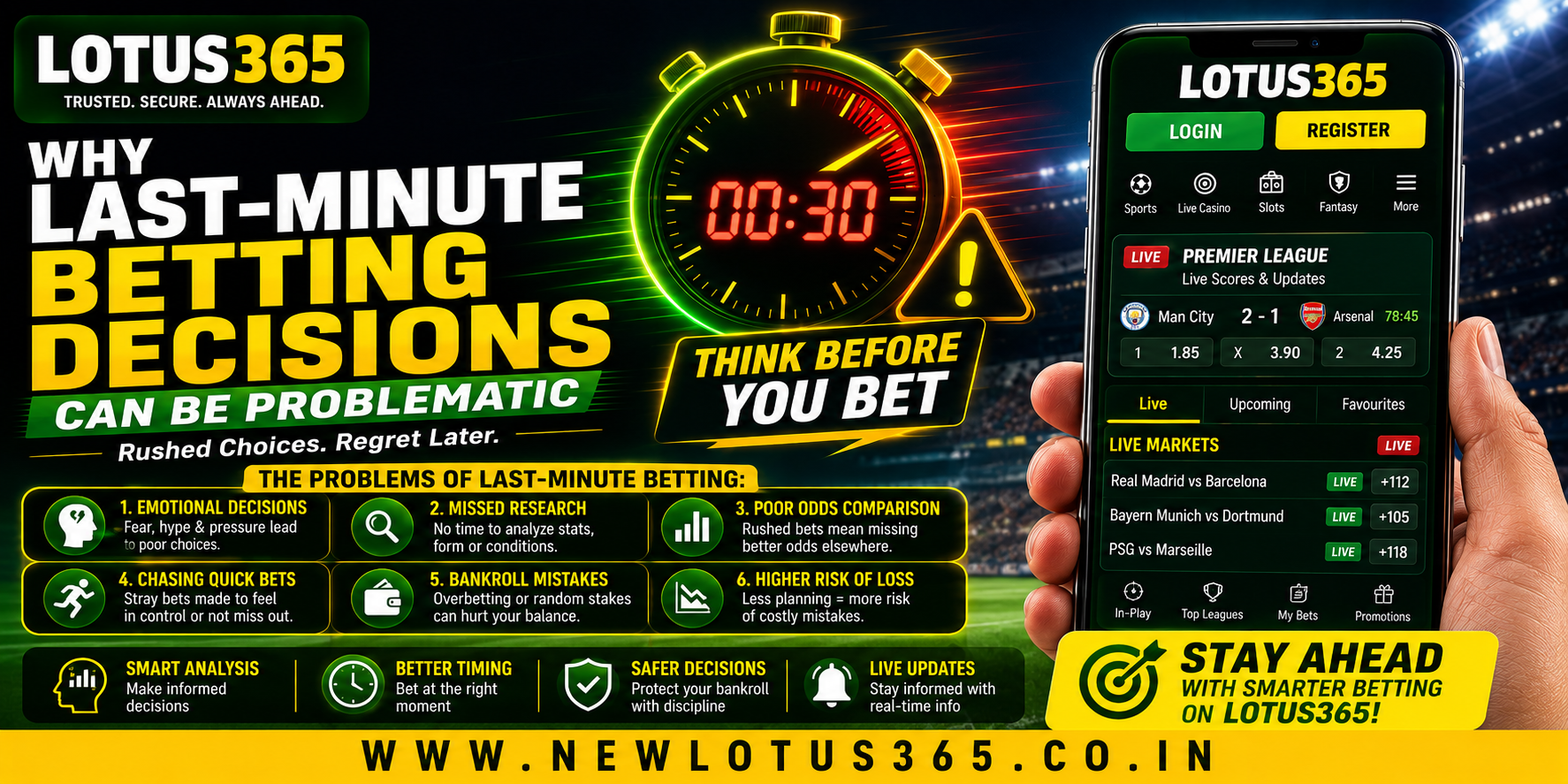
 Why Last-Minute Betting Decisions Can Be Problematic
 2026-08-17
Introduction
Making a decision immediately before an event starts can feel exciting, especially when new information appears quickly. However, rushing into a choice can make it harder to think clearly and evaluate the situation objectively. For people using Lotus365 to follow sports markets, understanding the risks of last-minute decisions can encourage a more disciplined and responsible approach.
What Are Last-Minute Betting Decisions?
A last-minute decision is one made shortly before an event begins or while there is very little time left to consider the available information.
These decisions may happen because of:
- A sudden team-news update
- A late change in the playing XI
- A dramatic change in market prices
- Pressure to make a decision before an event starts
- Fear of missing an opportunity
- An emotional reaction to recent events
Having new information is not necessarily a problem. The difficulty comes when there is not enough time to assess it properly.
Why Rushing Can Affect Judgment
When people have only a few moments to decide, they may focus on one piece of information while ignoring other relevant factors.
For example, a late player announcement could appear important, but its actual effect may depend on the player's role, replacement, conditions, and wider team combination.
A rushed decision can therefore be based on incomplete reasoning rather than a complete assessment.
1. Emotions Can Take Over
Last-minute situations can create excitement, anxiety, or fear of missing out.
Emotional reactions may encourage people to act without considering whether the decision fits their original plan.
A useful habit is to pause and ask:
- Why am I making this decision?
- Has anything genuinely changed?
- Am I reacting emotionally?
- Would I make the same decision with more time?
If the answer is unclear, stepping away can be the better option.
2. New Information May Be Misinterpreted
Late information can be valuable, but it can also be misunderstood.
A headline, social media post, or unofficial message may not provide the complete context. Team news can change quickly, and predicted lineups are not the same as confirmed selections.
Before relying on an update, users should check whether it comes from a credible source.
3. Market Movement Can Create Pressure
Prices can change rapidly close to an event. Seeing movement may create a feeling that immediate action is necessary.
However, movement itself does not guarantee that a particular outcome will happen.
A disciplined approach means recognising that:
- Prices can move in either direction.
- Market movement is not a guarantee.
- Shorter prices do not eliminate uncertainty.
- Missing an opportunity is not the same as losing money.
4. Last-Minute Decisions Can Break a Plan
A pre-event plan can help establish clear boundaries. Rushing at the final moment can cause someone to abandon those boundaries.
For example, a person may originally decide to stay within a specific entertainment budget but become tempted to change that limit after seeing unexpected market movement.
A plan is useful only when it is followed consistently.
5. Chasing Losses Becomes Easier
One of the biggest concerns is making another decision simply because an earlier one did not work out.
This can create a cycle:
- An unexpected result occurs.
- The person feels disappointed.
- A quick new decision is made.
- Another poor outcome increases frustration.
- The person attempts to recover immediately.
This approach can lead to increasingly emotional decisions.
How to Handle Late Information
Not every late update requires an immediate response. Instead, consider whether the information materially changes the situation.
A simple checklist can help:
- Confirm the source.
- Understand what has changed.
- Consider the wider context.
- Review your original plan.
- Check your personal limit.
- Decide whether waiting is more sensible.
There is nothing wrong with choosing not to participate when the available information is unclear.
Use Technology Carefully
Mobile platforms make sports information accessible almost instantly, but convenience can also encourage impulsive decisions.
Users accessing sports markets through a Lotus365 ID should keep account credentials private and avoid clicking suspicious links or messages claiming to provide special opportunities.
Technology should make information easier to access, not encourage rushed behaviour.
Responsible Habits Can Make a Difference
Responsible participation involves recognising that sports outcomes are uncertain. No strategy, market movement, player update, or prediction can guarantee a particular result.
Helpful habits include:
- Set a personal spending limit.
- Never use money needed for essential expenses.
- Avoid chasing losses.
- Take breaks when emotions become strong.
- Do not borrow money for betting.
- Stop when participation is no longer enjoyable.
- Follow applicable age and legal requirements.
When Walking Away Is the Better Choice
Sometimes the best decision is not making one.
If the available information is confusing, emotions are high, or there is pressure to act immediately, waiting or walking away can protect your original plan.
A missed opportunity does not need to become a reason for making a poor decision.
Conclusion
Last-minute betting decisions can be problematic because they often combine limited time, emotional pressure, rapidly changing information, and the temptation to act immediately. New information can be useful, but it should be evaluated rather than followed automatically.
The most practical approach is to establish clear limits, verify important updates, consider the wider context, and accept that there will always be another sporting event. Responsible participation means being comfortable with both making a decision and choosing not to make one.
FAQs
Why can last-minute betting decisions be risky?
They may be influenced by emotions, incomplete information, market pressure, or fear of missing an opportunity.
Does late team news always mean I should change my decision?
No. Team news should be considered alongside the player's role, replacement, conditions, and overall match context.
Can market movement predict the result?
No. Market movement does not guarantee a particular sporting outcome.
How can I avoid impulsive decisions?
Set clear limits beforehand, verify information, avoid emotional reactions, and give yourself permission to walk away.
Is it better to skip a decision when information is unclear?
Yes. If you cannot evaluate the situation properly or feel pressured to act, choosing not to participate can be the more responsible option.